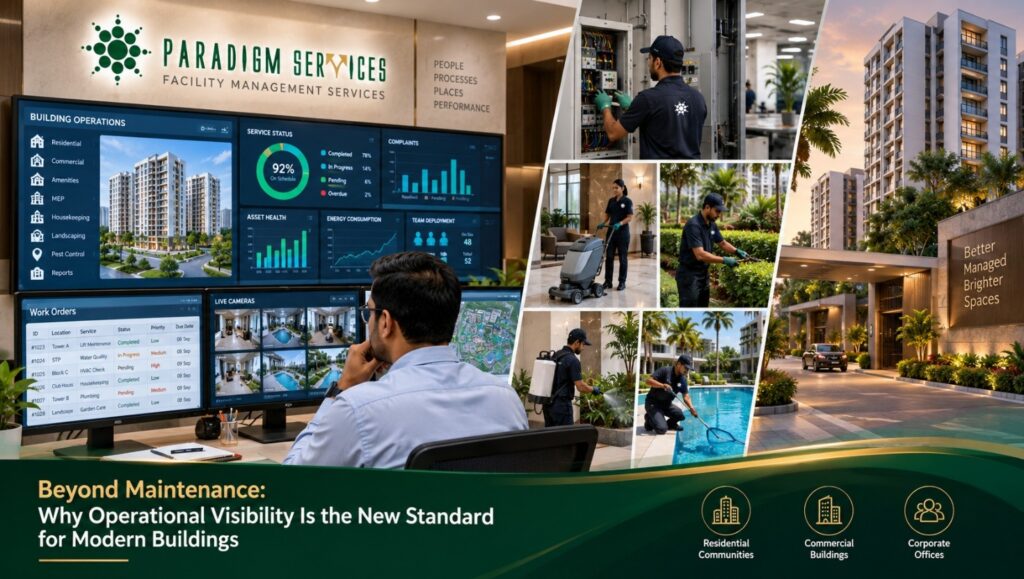
A well-managed building is not defined only by how quickly problems are fixed. True facility management is about knowing what is happening across the property before small issues become major concerns.
For large residential communities, gated communities, commercial buildings, and corporate offices, daily operations involve hundreds of activities. From maintenance and housekeeping to utilities, complaints, inspections, vendors, and common-area management, keeping track of everything can be challenging without proper visibility.
This is why operational visibility is becoming an essential part of modern facility management.
What Does Operational Visibility Mean?
Operational visibility means having a clear understanding of what is happening across a property at any given time.
It involves tracking service activities, pending issues, maintenance schedules, inspections, manpower deployment, recurring problems, and overall performance.
Instead of relying only on verbal updates or waiting for complaints, facility managers can use structured reporting and monitoring to understand where attention is required.
Visibility Leads to Better Decisions
Good decisions depend on good information.
When facility teams maintain accurate records and regular reports, management can identify recurring issues, understand resource requirements, prioritize critical tasks, and make informed operational decisions.
For example, if a particular building system repeatedly requires attention, the facility team can investigate the underlying cause instead of continuing to address the same issue.
This turns facility management from a reactive function into a more informed and strategic operation.
Improving Accountability Across Teams
Large properties often involve multiple teams and service activities. Without clear monitoring, it can become difficult to determine whether scheduled tasks have been completed properly.
Checklists, service reports, inspection records, attendance monitoring, and performance reviews create greater accountability.
Every team understands what needs to be done, when it needs to be completed, and how the outcome will be evaluated.
This creates greater consistency across daily operations.
From Data to Proactive Management
Operational visibility becomes particularly valuable when information is used proactively.
Instead of waiting for equipment failure, repeated complaints, or service gaps, facility managers can identify warning signs and take action earlier.
Regular reporting can highlight patterns such as recurring maintenance requests, increased resource consumption, delayed tasks, or areas requiring additional attention.
The objective is simple: identify, understand, and act before the issue escalates.
Better Communication with Stakeholders
Facility management involves property owners, management committees, residents, employees, vendors, and service teams.
Clear reporting creates a common understanding among all stakeholders. Management teams can communicate what has been completed, what is currently pending, and what actions are planned.
This transparency builds confidence and reduces misunderstandings.
The Future of Facility Management
Modern facility management is moving beyond simply maintaining buildings. It is becoming increasingly focused on performance, transparency, accountability, and continuous improvement.
At Paradigm Facility Management Services, we understand that effective facility management requires visibility across every aspect of property operations. Through structured processes and professional management of Administrative Services, Housekeeping, Landscaping, MEP Services, Technical Audits, HOTO Services, Pest Control, and Swimming Pool Maintenance, we help properties operate with greater control and consistency.
When you can see your operations clearly, you can manage them better. And when you manage them better, your building performs better.