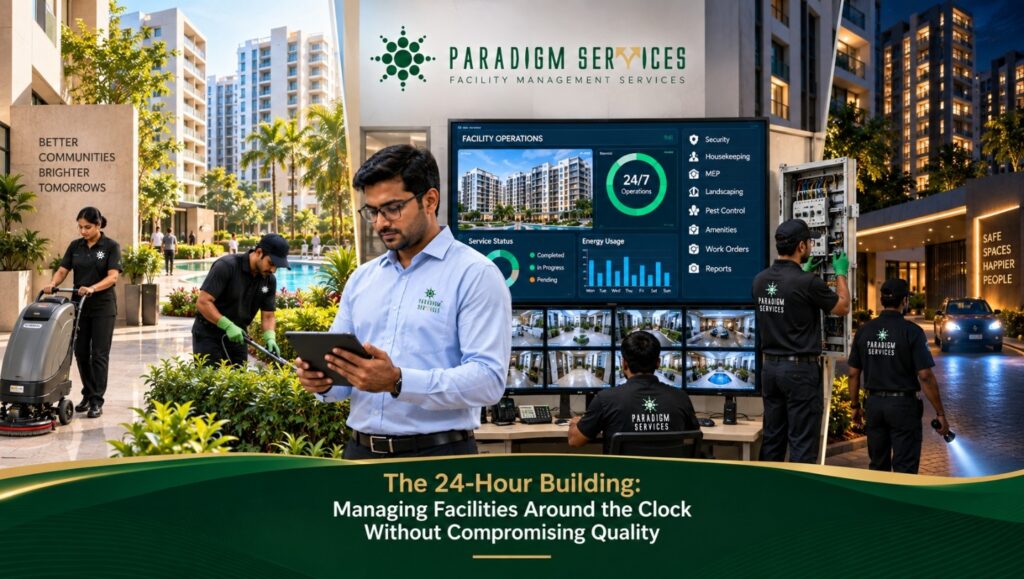
Modern buildings never truly sleep. Large residential communities, gated communities, commercial buildings, and corporate offices continue to operate early in the morning, throughout the working day, and well into the night. Residents return home, employees work different shifts, visitors arrive, equipment operates continuously, and essential building systems remain active around the clock.
This creates an important challenge: How can facility management maintain consistent quality at every hour of the day?
The answer lies in structured planning, skilled teams, clear processes, and continuous coordination.
A Building’s Needs Change Throughout the Day
Facility requirements are rarely the same at 8 AM and 11 PM. Morning hours may involve high activity in common areas, employee arrivals, housekeeping schedules, and equipment checks. During the day, operational teams manage regular maintenance and service requirements. At night, the focus may shift toward essential monitoring, emergency response, safety, and preparing the property for the next day.
Professional facility management recognises these changing requirements and plans manpower and activities accordingly.
The Right People at the Right Time
24-hour facility management is not simply about having staff available around the clock. It is about having the right skills and responsibilities assigned to each shift.
Effective shift planning ensures that critical functions are covered without unnecessary duplication. Proper handovers between teams are equally important. Pending issues, completed tasks, equipment concerns, and special instructions must be communicated clearly from one shift to the next.
A strong handover process ensures that operations continue smoothly instead of restarting with every shift.
Consistency Is the Real Challenge
Maintaining quality across multiple shifts can be difficult. Different teams may have different working styles, which can result in inconsistent service delivery.
Standard operating procedures, checklists, inspection routines, and clearly defined responsibilities help maintain the same service standards throughout the day.
Whether it is housekeeping, MEP operations, administrative coordination, landscaping, pest control, or facility inspections, every team should understand the expected standard and follow a consistent process.
Preparedness Reduces Disruptions
Unexpected problems do not follow office hours.
A plumbing issue, electrical fault, equipment failure, or other operational concern can occur at any time. Professional facility teams therefore need clear escalation procedures and emergency response protocols.
Quick identification, proper communication, and timely action can prevent a minor issue from becoming a major disruption.
Technology Supports 24-Hour Operations
Digital tools can make round-the-clock facility management more efficient. Maintenance tracking, digital checklists, attendance systems, service requests, equipment monitoring, and reporting platforms provide better visibility into ongoing operations.
Technology does not replace facility professionals. Instead, it gives them better information to make faster and more informed decisions.
The Morning Starts with What Happened Overnight
One of the most overlooked aspects of 24-hour operations is the transition between shifts.
A properly documented night shift gives the morning team a clear picture of what happened, what was resolved, and what requires further attention. This continuity prevents information gaps and helps the next team start work with confidence.
A well-managed 24-hour building is not achieved simply by keeping people on-site. It requires planning, coordination, accountability, communication, and consistent standards across every shift.
At Paradigm Facility Management Services, we help residential communities, gated communities, commercial buildings, and corporate offices maintain reliable operations through professional and structured facility management.
Because when a building operates around the clock, its facility management should be prepared to do the same—without compromising quality.